
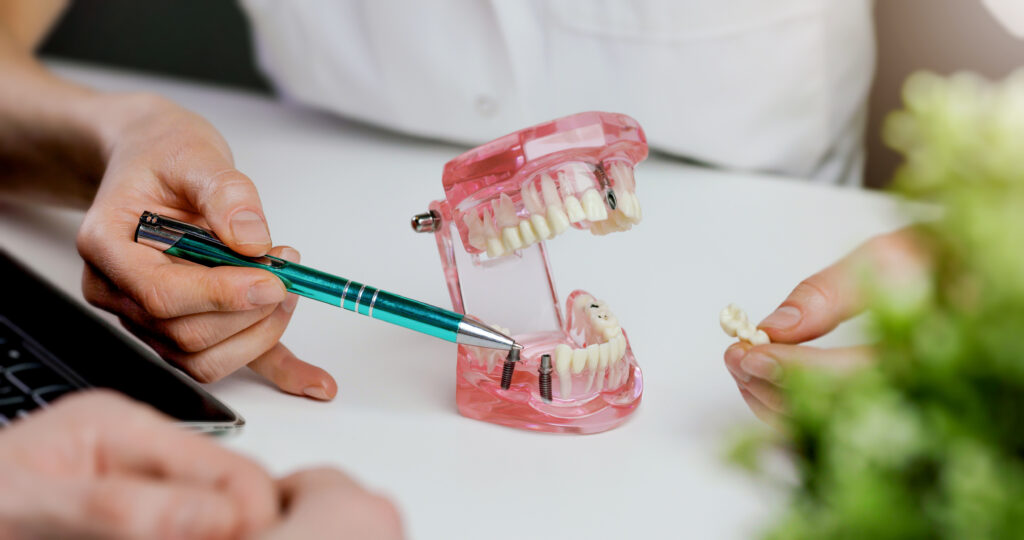
Missing teeth? Ultra-Short and All-on-4 implants offer a lasting solution, with faster recovery and a natural look.
At Newlife Dental Practice, we help every patient understand their options so they can make an informed decision.
Dental implants are artificial tooth roots surgically fixed into the jawbone to replace missing teeth. Unlike traditional dentures or bridges, dental implants provide a permanent, stable solution for tooth loss.
A dental implant consists of the implant, the abutment, and the crown, which replicates the appearance of a natural tooth. With this treatment, you can not only restore your smile but also improve the functionality of your teeth and your overall oral health.
Most patients living with missing teeth have already adapted in ways they barely notice, yet it affects their daily life. They choose softer foods (and are scared to bite into apples). They close their mouth when they smile in photos. They speak carefully to avoid drawing attention to a gap. Over time, these small adjustments compound.
The clinical consequences of untreated tooth loss are well-documented, but the everyday struggles are less discussed. If you have been living with missing teeth, you may have been experiencing:
The loss of biting surface forces other teeth to compensate, changing how you eat and potentially affecting digestion
Neighbouring teeth gradually drift toward the gap, altering your bite and potentially causing jaw discomfort over time
Without a tooth root stimulating the jawbone, the bone in that area begins to shrink, a process that continues silently the longer the gap remains
Depending on the location of missing teeth, certain sounds become harder to produce clearly
As jawbone reduces, the face can appear to sink inward, ageing the appearance
The tissue surrounding a gap can recede and become more vulnerable
Uneven bite forces can place stress on remaining teeth and jaw joints over time
The longer these go untreated, the more complex dental treatment becomes. If any of the above resonate with you, it is worth understanding your treatment options.

Ultra-short dental implants are designed for patients with limited jawbone height due to age-related bone loss, previous extractions, or other conditions. Traditional implants often require bone grafting to ensure sufficient depth. In contrast, ultra-short implants are built to anchor securely in shallower bone, reducing the need for additional surgical procedures.
Despite their compact size, ultra-short implants share the same three essential parts as conventional implants:
Ultra-short implants can be placed in areas with limited vertical bone height, eliminating the need for additional procedures to compensate for low bone density.
Because ultra-short implants typically do not require bone augmentation, they are often more affordable. Fewer surgeries mean lower overall treatment costs.
The procedure involves fewer major surgical interventions, resulting in shorter surgical times, less discomfort, and quicker recovery.
Recent studies show that ultra-short implants have success rates comparable to traditional dental implants, providing a reliable tooth-replacement solution.
All-on-4 dental implants are suitable for individuals missing most or all of their teeth. This treatment places four strategically positioned implants in both jaws to support a full arch of prosthetic teeth, restoring function and appearance as a long-term alternative to traditional dentures.

Newlife Dental Practice follows a three-stage dental implant process. Each stage has a specific clinical purpose, and understanding what happens at each point helps patients approach treatment with realistic expectations.
Before any treatment is recommended, we carry out a thorough evaluation of your oral health, bone structure, and medical history. This includes CBCT imaging, which provides a three-dimensional view of your jawbone, its height, width, and density, as well as the position of key structures such as the maxillary sinus and mandibular nerve.
This assessment is where your individual treatment plan takes shape. It determines which type of implant is appropriate, where implants will be placed, and whether any preparatory procedures are needed before surgery.
At the surgical stage, titanium implant fixtures are placed into the jawbone according to your treatment plan. The procedure is carried out under local anaesthesia. Following placement, a healing period begins during which the implant integrates with the surrounding bone, a biological process called osseointegration.
The duration of this healing phase varies between patients, typically several weeks to a few months, depending on bone quality, implant position, and individual healing response.
Once your implants have fully integrated, the restorative phase begins. Custom-made crowns, bridges, or prosthetic arches are designed to match your natural teeth in shape, colour, and function. The final restoration is then fitted, completing the treatment.
Whether you are replacing a single tooth or a full arch, the restoration is designed to function naturally while harmonising with your existing teeth.
The complexity of the case determines the cost of dental implants in Singapore, the type of implant chosen, and whether additional procedures are required. At Newlife Dental, our Dental Implant fees are S$4500 before GST, of which $1950 is medisave claimable.
The cost covers: Initial Consultation and Assessment, Implant Surgery, Restoration, and Follow-Up Appointments.


Type of Implant: short or ultra-short implants are usually more affordable; zygomatic implants for severe bone loss are more expensive.
Additional Procedures: bone grafts or sinus lifts can add $1,000 to $2,500 to the total cost
Number of implants: At Newlife Dental Practice, All on 4 Implants are S$25,000 before GST, of which $1,950 is Medisave claimable.
Materials Used: titanium implants are common and durable; newer materials may increase overall cost
In Singapore, Medisave can be used to offset part of the cost of surgical dental procedures. You may claim up to $1,950 per implant, and a Medisave-accredited dentist must perform procedures in an approved clinic such as Newlife Dental Practice.
Some private health insurance policies or Integrated Shield Plans may cover dental implants. We recommend checking directly with your insurer for details about your individual coverage.
Our team is happy to assist with preparing documentation for Medisave claims, submitting insurance paperwork, and explaining instalment plans for any out-of-pocket costs.
Here is a comparison of dental implants, bridges, and dentures across key factors:
| Lifespan | 15-25 years or more with proper care | 10-15 years with proper care | 5-8 years removable; up to 10 years fixed |
| Biting Strength | 80-95% of original tooth | 60-70% of original tooth | 30-40% of original tooth |
| Conditions | Requires sufficient bone; ultra-short minimises grafting need | Requires adjacent healthy teeth for support | Can be used even with significant bone and tooth loss |
| Maintenance | Minimal. Regular hygiene like natural teeth | Requires special cleaning, careful flossing under the bridge | Requires daily removal and cleaning |
| Aesthetics | Most natural appearance and feel | Good aesthetics, may not be as natural as implants | Less natural, especially removable types |
| Comfort | High comfort, feels like natural teeth | Generally comfortable, depends on fit | It can be uncomfortable if not well-fitted |
| Bone Preservation | Prevents bone loss by stimulating the jawbone | Does not prevent bone loss | Does not prevent bone loss |
| Cost | $4,500 per implant | $3,000-$4,500 per bridge | $300-$5,000 (varies by type) |
Reduced bone is one of the most common concerns patients bring to an implant consultation, and one of the most frequently misunderstood. The presence of bone loss does not automatically rule out implant treatment. What it does is shape which approach is most appropriate.
There are several options for patients with low bone density, and the right one depends on the extent of the bone loss, the location in the jaw, and your overall health:
Bone grafting adds bone material to areas of the jaw that lack sufficient volume. Over time, the graft integrates with natural bone, creating a stable foundation for implant placement.
Short implants are designed to work within reduced bone. In many cases, they can be placed without grafting, making treatment shorter and less invasive.
For patients with bone loss in the upper back jaw, a sinus lift creates the vertical bone height needed for implant placement. The sinus membrane is elevated, and bone graft material is placed in the space created.
In cases of severe bone loss where neither standard implants nor grafting are viable, zygomatic implants may be an option. These are anchored to the cheekbone (zygoma) rather than the jawbone.
At Newlife Dental Practice, every low bone density case is assessed individually. The sections below take a closer look at two of the most commonly recommended options and what modern implant planning has changed about both.

Many patients arrive at their first consultation having already been told they need a bone graft. For some, that recommendation is entirely appropriate. For others, it may be worth understanding what grafting actually involves, when it is genuinely necessary, and whether all the options have been properly considered.
The jawbone exists largely to support the roots of teeth. When a tooth is lost, the bone surrounding that root no longer receives stimulation from chewing forces and begins to shrink, a process called bone resorption. The rate and extent of this shrinkage vary considerably between individuals. Some patients retain adequate bone for implant placement years after tooth loss. Others lose significant volume relatively quickly, influenced by whether gum disease was involved, whether dentures have been worn, and the specific location in the jaw.
In the upper back jaw, the situation is further complicated by the maxillary sinus, which often expands downward into the space left by missing teeth. The combined effect can significantly reduce the bone height available for implant placement.
Bone grafting is not a single procedure. It covers a range of techniques that vary significantly in scale:
The recovery period, surgical complexity, and treatment timeline all vary depending on the extent of grafting required.
A common assumption is that more bone automatically means better outcomes. In reality, long-term implant success depends on a combination of factors:
In many clinical situations, preserving stable native bone, even if limited in quantity, may be more important than aggressively attempting to create larger bone volume through extensive grafting.

At Newlife Dental Practice, no grafting recommendation is made without a CBCT scan, which provides a detailed three-dimensional picture of bone height, width, density, sinus anatomy, and nerve position, far more precise than a standard X-ray. This assessment covers:
In some cases, CBCT reveals that available bone is more suitable than initially anticipated. In others, it confirms augmentation is the right path.
Yes. Advances in implant surface technology, thread design, and surgical planning have expanded treatment options for patients with reduced bone. A growing body of systematic reviews has demonstrated comparable survival rates between short implants and conventional implants with sinus augmentation in carefully selected cases.
Some patients who were previously told that grafting was unavoidable may now qualify for alternative approaches, depending on their anatomy, bone quality, and potential for stability. Every case at Newlife Dental Practice is assessed individually.
Bone grafting is not an outdated approach. There are clear clinical situations where it remains the most predictable path to a stable, long-term outcome:
The goal is not aggressive treatment. The goal is appropriate treatment.
If you have been told you need bone grafting, or if you are unsure whether it applies to your situation, a consultation at Newlife Dental Practice, including CBCT imaging, can give you a clear, anatomy-specific answer.

Of all the procedures associated with dental implants, sinus lift surgery is one of the most anxiety-inducing for patients. Understanding what the procedure actually involves, when it is genuinely necessary, and what alternatives may exist can help patients make clearer decisions.
The maxillary sinus is an air-filled cavity that sits directly above the upper back teeth. After those teeth are lost, two things tend to happen simultaneously: the bone below shrinks through resorption, and the sinus expands downward into the space left behind. Over time, this can leave very little vertical bone height for implant placement.
For many years, the standard response was a lateral sinus lift, a procedure that elevates the sinus membrane from the side and packs bone graft material into the space created. It is a well-established procedure with a strong evidence base, and in many cases it remains the right choice.
A sinus lift is performed under local anaesthesia. The sinus membrane is carefully elevated, and bone graft material is placed beneath it to build vertical height. A healing period follows before implants are placed into the newly formed bone.
In some cases, where sufficient primary stability can be achieved, implants may be placed at the same time as the sinus lift, reducing overall treatment time. In others, staging the procedure is the more predictable approach.
Not necessarily, and this is where modern implant dentistry has evolved meaningfully. Developments in technique and implant design have introduced alternatives for carefully selected cases:
The objective is not to avoid surgery at all costs. The objective is to choose the least invasive approach that can achieve stable long-term outcomes.
Every upper jaw case at Newlife Dental Practice is assessed using CBCT imaging, which measures available bone height precisely and maps sinus anatomy. It evaluates whether implant stability can be achieved within the existing bone.
Some patients require sinus augmentation. Others may qualify for alternatives. What guides the recommendation is always the same question: what approach offers the best balance of stability, biology, recovery, and long-term predictability for this individual patient? This decision-making process is informed by the Sinus Stability Protocol, a clinical framework developed by Dr Aaron Hoo and documented in a forthcoming book.
If sinus surgery has been recommended to you elsewhere and you would like to understand your full range of options, a consultation and CBCT assessment at Newlife Dental Practice can provide clarity.

Many older patients have been living with missing teeth or struggling with dentures for years before they consider implant treatment. Many assume, before they even ask, that they are simply too old for it.
Age alone is rarely the deciding factor. Patients in their 70s and beyond can and do successfully receive dental implant treatment. What matters more than age is overall health, bone condition, and healing capacity, all of which are assessed individually.
The consequences of tooth loss often compound over time, and older patients carry those consequences more heavily:
Older patients may present with additional clinical considerations, including reduced bone volume, systemic conditions such as diabetes or osteoporosis, medications including blood thinners or bisphosphonates, and a slower healing response.
None of these factors automatically excludes a patient from implant treatment. They do, however, make the quality of the assessment and the thoughtfulness of the treatment plan more important.
A medically stable 75-year-old with well-controlled health conditions and good oral hygiene may be a considerably better implant candidate than a younger patient with poorly controlled diabetes or a heavy smoking history.
For older patients, especially those who are medically compromised or anxious, the ability to reduce surgical burden is a clinically meaningful consideration. Modern implant planning, including short implant concepts where anatomy permits, may allow some older patients to receive treatment that would previously have required more extensive surgery.
CBCT imaging gives a detailed, three-dimensional picture of the jaw that significantly reduces surgical uncertainty. It allows precise measurement of available bone, identification of risk areas, and careful planning of implant position before any procedure begins. For older patients especially, this level of pre-surgical clarity is valuable.
The most important question is not how old you are. It depends on whether your health and anatomy support a well-planned treatment.
If you have been putting off implant treatment because of age, or because you have been told it is not possible, a consultation at Newlife Dental Practice may help clarify what is achievable for your specific situation.

Patients with diabetes are sometimes told that implant treatment is not an option for them. This blanket exclusion does not reflect the current understanding of how diabetes interacts with implant treatment.
Diabetes does not automatically disqualify a patient from dental implants. It introduces specific factors that require honest assessment and careful planning.
Diabetes affects several biological processes directly relevant to implant treatment:
The most important single factor in assessing a diabetic patient is glycaemic control, specifically how well blood glucose levels are being managed. HbA1c is the most commonly used marker. Well-controlled diabetes with HbA1c within an acceptable range is generally considered compatible with implant treatment, provided other factors are favourable.
Beyond glycaemic control, assessment at Newlife Dental Practice considers the type and duration of diabetes, the presence of complications such as neuropathy or vascular disease, current medications, baseline gum health, and overall medical stability.
Diabetic patients who proceed with implant treatment with well-controlled blood glucose, good oral hygiene, and a genuine commitment to long-term maintenance can achieve stable outcomes in many cases. The evidence base supports this.
The commitment to ongoing care is not optional for this patient group. Implant longevity in diabetic patients depends heavily on maintaining gum health, attending regular professional reviews, and sustaining good glycaemic control over the long term.
The question is not whether you have diabetes. It is whether your diabetes is well-managed, and whether the rest of the picture supports a safe and predictable treatment plan.

Dental implants are designed to last. With consistent care, many patients keep their implants functioning well for 15 years or longer.
At home, implants are maintained the same way as natural teeth: brushing twice daily, flossing, and using an interdental brush to clean around the implant base, where plaque can accumulate. No special adhesives or soaking routines are required.
At the clinic, we schedule regular check-up appointments to assess the implants and surrounding tissue. These appointments allow us to:
How often these appointments are scheduled depends on your individual situation; they are typically held every six to twelve months alongside routine dental check-ups.
Bone and gum changes around implants do not always produce obvious symptoms in the early stages. Regular monitoring helps identify small issues early, before they become more complex.
At Newlife Dental Practice, implant treatment begins with a thorough assessment and a treatment plan specific to the individual patient, their anatomy, health history, and goals. There is no single protocol applied uniformly across every case.
For patients with more complex presentations, including reduced bone volume, medical conditions, or prior dental history that complicates treatment, this case-by-case approach matters most. What guides each recommendation is what the assessment actually shows. Implant treatment at Newlife Dental Practice is backed by a 5-year warranty covering material defects, fractures, and workmanship issues, provided routine care and hygiene reviews are maintained. Full terms are available on our Warranty page.

Dr Aaron Hoo, the Director of Newlife Dental Practice, BDS (National University of Singapore, Dean’s List), has years of practice in dental implantology. He is a Fellow of the International College of Dentists (2017) and a Fellow of the International College of Continuing Education (2015). In 2009, he represented Singapore at the SEAADE conference and won the research competition at the South-East Asian level; he was subsequently invited to present at the American Dental Association Conference in Orlando in 2010.
Dr Aaron is the founder of the ‘Challenge to Succeed’ Masterclass Series, through which he teaches fellow dentists on dental implants, smile makeovers, and advanced dentistry. He developed the Sinus Stability Protocol, a clinical framework for assessing and managing sinus-related implant cases, and is completing a book on the subject. His treatment planning is guided by each patient’s individual anatomy, health history, and goals. Using CBCT imaging and digital treatment planning, Dr Aaron maps each implant case in three dimensions before any procedure begins. This preparation informs placement position, implant selection, and the management of any anatomical considerations specific to each patient.
Whether you are replacing a single tooth or addressing full-arch tooth loss, Dr Aaron and the team at Newlife Dental Practice are available to discuss what treatment may look like for your specific situation.
At Newlife Dental Practice, the cost of dental implants is from $4500 per implant, of which $1950 is Medisave claimable. All-on-4 implants, which are a full set of implants, are from $25,000.
The whole dental implant process can take 4 to 9 months. This includes the first consultation, placement of the implant, healing time for osseointegration, and the final placement of the crown or bridge.
The All-on-4 technique involves placing four implants in the jaw to support a full set of dentures. This technique is a great option for patients who need a full-mouth restoration, providing a stable and fixed alternative to removable dentures.
We’re happy to answer any questions you might have, or to help schedule a visit to our dental clinic. For urgent matters or appointment, please call or WhatsApp us.


